
Stureplan, Stockholm: the Square, the Galleria and Who It Suits
Stureplan is worth roughly an hour of a Stockholm city break, and only if glossy shopping and grand 1880s facades appeal to you. It is a public square sitting between Norrmalm and Östermalm, and it works best as a short stop folded into a longer walk rather than a destination in its own right. This guide covers what the square is, what to look at, where to eat on it and who should give it a miss.
Plan it as a half-hour loop through the Sturegallerian passage plus a longer look at the facades, and you will get what the square offers. Anyone who wants cobbled lanes and old-town atmosphere should spend that time in Gamla Stan instead, or make a separate, slower afternoon of Skeppsholmen for water and open views.
What Stureplan is and where it sits
Stureplan is a square in central Stockholm on the seam between Norrmalm and Östermalm. That position makes it easy to pass through on foot rather than detour to, since both districts are on the same side of the old town. The name dates from 1885, when the square was formally named, and was shortened from Stureplanen in 1932.
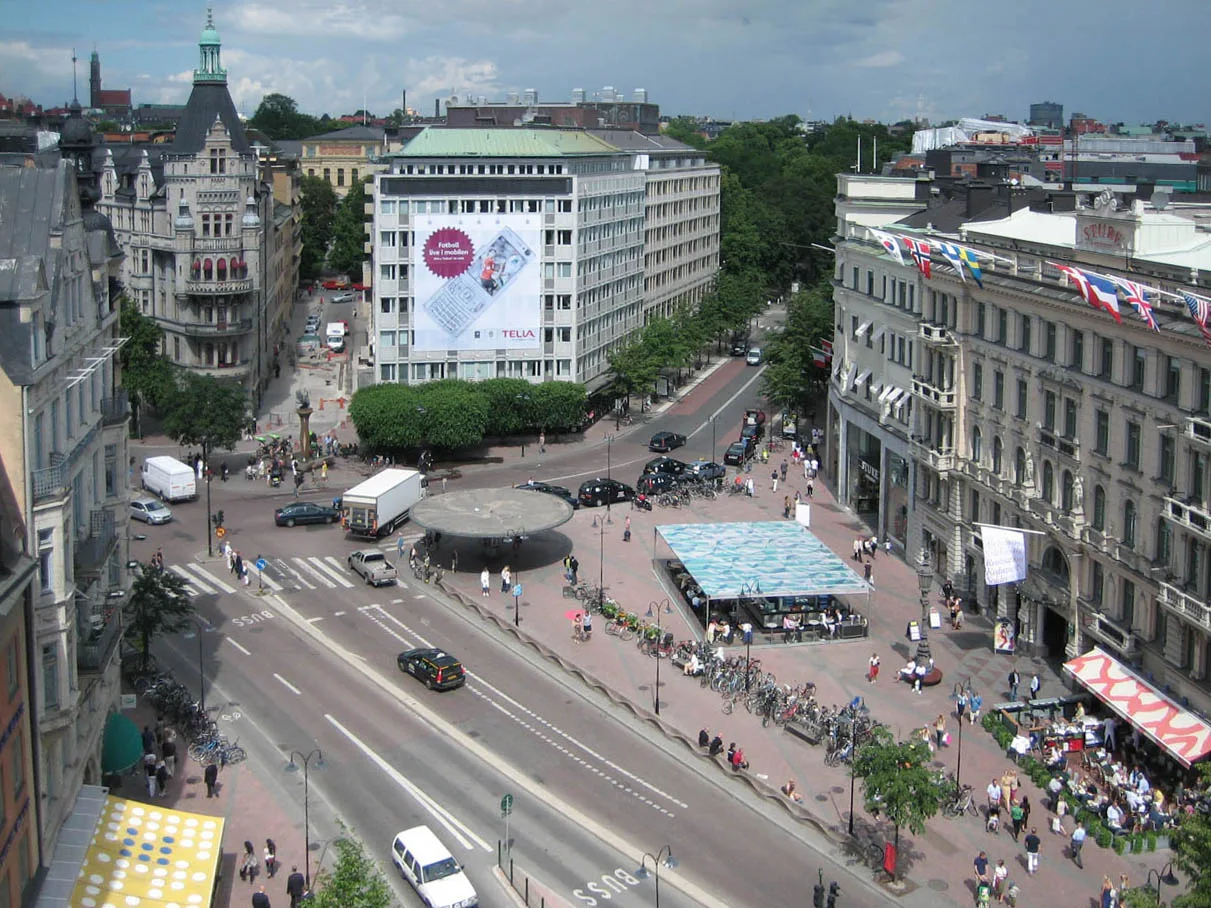
Its shape is more traffic junction than plaza, with roads running across it and the shopping passage tucked beneath and beside the street level. Treat it as a place to cross, look up and step into, not a square to sit in for an afternoon.

The character of the square: shops, cafés and fine dining
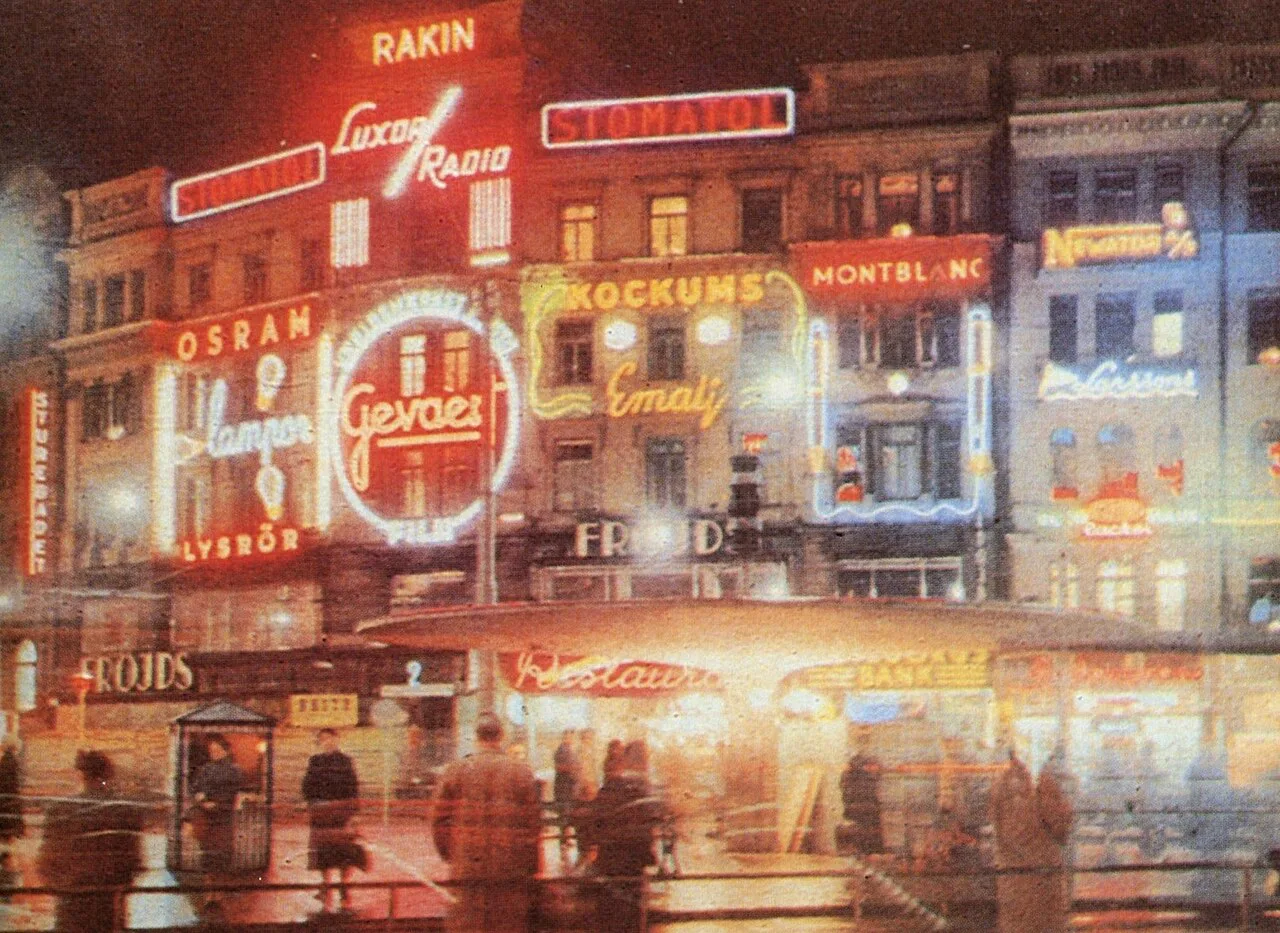
Stureplan has spent well over a century as Stockholm's upmarket showcase. Sturebadet and Hotel Anglais arrived in the 1880s, and NK traded on the square from 1902 before moving to its present site, cementing a reputation for luxury retail. In 1924 the square got Stockholm's first neon advertising sign, and by the 1950s it was the most expensive advertising spot in Sweden.
Daytime is shopping-led, with boutiques, street cafés and a dressed-up crowd drifting between them. The square's polished, expensive character carries into the evening as restaurants around it fill up. If that gloss reads as expensive window-dressing rather than a good day out, this is not your part of Stockholm.

Svampen: the concrete meeting point
Svampen, the mushroom-shaped concrete canopy, was inaugurated on 20 November 1937 and became Stockholm's unofficial meeting point for the next three decades. Architect Ragnar Östberg disliked it enough to call it a lump of concrete, which tells you plenty about how it divided opinion at the time. It stood as a kiosk and newspaper stand and doubled as shelter from rain.
Tram traffic gave way to cars in 1967 and the square lost its role as the city's favourite rendezvous to Sergels Torg. Svampen was removed in 1988, public objection followed, and an almost exact copy went up a year later as Sturegallerian opened. Look for the copy rather than the original, and note that its position is not the 1937 one.
Sturegallerian: the shopping passage
Sturegallerian opened in 1989 and is the reason the square revived, folding shops, cafés and the rebuilt Sturebadet under one roof. Close to thirty boutiques occupy the passage, from Björn Borg and J. Lindeberg to Whyred, so it covers Swedish fashion in a single indoor loop.
Hedengrens, a bookshop trading for more than a century, sits inside the galleria and stocks roughly 80,000 titles across nine languages. It is the best reason for a non-shopper to walk through, and a natural pause if rain has set in. Shops here keep their own hours, so check the galleria's own listing before you build a day around it.
The architecture worth looking up for
Daneliuska huset went up in 1900 as a luxury apartment block designed by Erik Josephson, and its richly carved stone in an early French Renaissance style drew sharp criticism from the trade press for abandoning stucco. It was nearly demolished in 1966, saved when a protest letter signed by cultural figures reached the City Council.
Carlssons lykta, the cast-iron gas lantern designed by sculptor Daniel Carlsson in 1885, carries lions' heads and Stockholm's city seal of Saint Eric, with a bench built into its base. When the square was redesigned in 1990 it was given a place of honour outside the Sturegallerian entrance. Both are quick finds: the lantern at the galleria door, the stone facade among the surrounding blocks.
Building work on the wider Sturekvarteret block began in 2022, with plans to alter and replace structures and add glazed space for more restaurants. Expect some surroundings to shift rather than assume the square looks as it did a decade ago.
Sturebadet, the 1885 bath institution
Sturebadet opened in 1885 and helped establish the square as a meeting place for the affluent. A fire destroyed it in 1985, exactly a century after it opened, and it was resurrected as part of the new Sturegallerian development. Today it is an exclusive private spa rather than a public sight, so treat the entrance as something to pass rather than a place to tour.
Where to eat and drink on the square
Riche at Birger Jarlsgatan 4 is modelled on the Café Riche in Paris and has held its corner of the Stureplan area for over a century, with an interior that still leans on art. Sturehof at Stureplan 2 opened a few years later and remains the other long-standing address facing the square. Both are established places to sit down rather than quick stops, so book or arrive early if you want a table at a popular hour.
Prices and menus change with the season, so check their own sites before you commit to a dinner budget.
Who Stureplan suits, and who should skip it
Stureplan suits shoppers, architecture spotters and anyone who likes watching a well-dressed city go about its day. It also suits travellers who want a compact stop between Norrmalm and Östermalm without crossing to the old town.
Skip it if you came for cobbles, quiet courtyards and centuries-old lanes, because the square is a traffic-edged commercial space, not a picturesque one. Anyone travelling on a tight budget will find little here beyond window shopping. No source in this guide makes a safety claim about the area at night, so plan around your own comfort rather than a rating.
Getting there and what is within walking distance
Stureplan is reached on foot from Norrmalm and Östermalm, which is the simplest way to arrive and the way most of the surrounding streets will show it to you. Once you are on the square, the galleria, the lantern and Svampen are all within a couple of minutes of each other.
For a wider loop, continue west into Norrmalm's shopping streets or east into Östermalm's quieter blocks. If you want water, open views and a slower afternoon, Skeppsholmen is a short walk and bridge crossing away, and it makes a better resting place than this square.
How long Stureplan needs
Allow 30 to 60 minutes on a one to four day trip: enough for the galleria, the lantern, Svampen and a look at Daneliuska huset. Weave it into a morning that also takes in Norrmalm, and you will not need to come back.
If you are eating at Riche or Sturehof, add 90 minutes to two hours and make the meal the point of the visit rather than a side note. Treat the square as a punctuation mark in a day of walking rather than the day itself, and it earns its place.
Should Stureplan make your Stockholm plan?
Include Stureplan if you want a compact dose of upmarket Stockholm, a look at the Sturegallerian boutiques and a bench beside Svampen. Leave it out if your trip is built on old-town lanes, water views and cheaper days, because those are elsewhere in the city.
Whichever you choose, put the square in the middle of a walking route rather than at the end of a tram ride, and it will cost you less time than you expect.
Explore more Stockholm guides
Frequently Asked Questions
Is Stureplan worth visiting in Stockholm?
Yes, if you like shopping and grand facades, but it is a short stop of 30 to 60 minutes rather than a sight in itself. The Sturegallerian passage, Svampen and Daneliuska huset are the three things actually worth seeking out.
Is Stureplan good for shopping?
It is the closest Stockholm comes to a luxury shopping quarter. Sturegallerian holds close to thirty boutiques, including Swedish fashion labels, plus the long-established Hedengrens bookshop inside the passage.
What is Svampen at Stureplan?
Svampen is the mushroom-shaped concrete canopy inaugurated in 1937, once Stockholm's best-known meeting point. The original was removed in 1988 and an almost exact copy was erected in 1989 near the Sturegallerian entrance.