
Sergels Torg: Stockholm's Modern Square and Glass Obelisk

Sergels Torg is the modern square at the heart of Norrmalm, and half an hour is enough to see it properly. It sits above and beside T-Centralen, so most visitors pass through it whether they plan to or not. This guide covers the two levels, the glass obelisk, Kulturhuset and the streets that meet here, so you know what you are looking at when you step out of the metro.
What Sergels Torg Is and Where It Sits in Norrmalm
Sergels Torg is a major public square in Stockholm's Norrmalm district, built in the 1960s and named after the 18th-century sculptor Johan Tobias Sergel. It works as both a transport hub and a stage for demonstrations and public gatherings rather than as a sight with a queue outside. Treat it as the place where modern Stockholm meets itself: commuters crossing, shoppers cutting through, and the occasional rally.
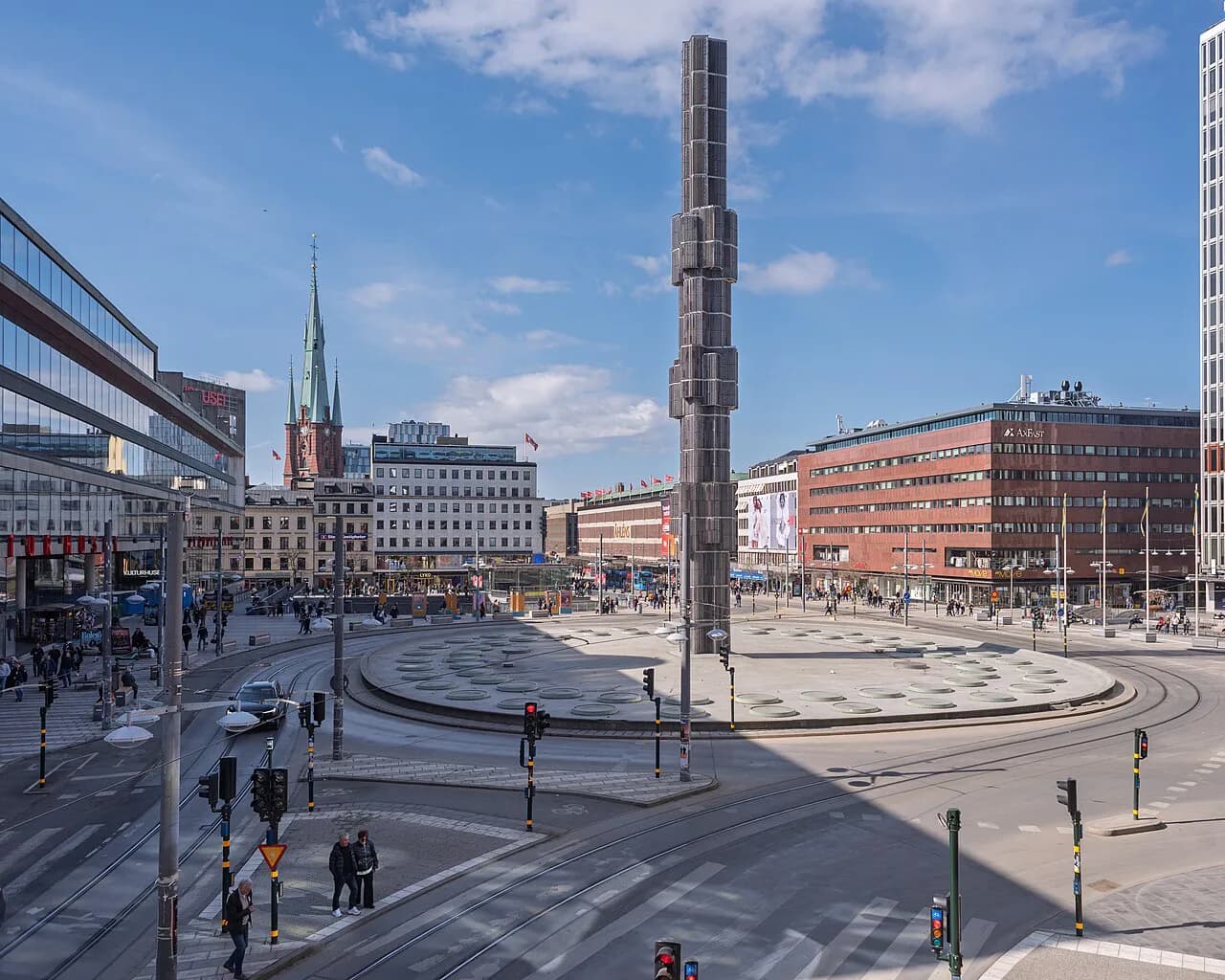
The square is not one flat surface, which is the single most useful thing to understand before you arrive. There is a sunken lower level known as Plattan and a raised section around the central obelisk, with Kulturhuset forming the south edge and Åhléns City and Drottninggatan close by. Knowing which level you are on explains why the tiles suddenly tilt beneath your feet and why the obelisk appears to rise out of a bowl.

Getting There from T-Centralen and Drottninggatan
Sergels Torg sits directly on top of T-Centralen, Stockholm's main metro and rail hub, so the square is effectively the exit rather than a separate journey. Coming up from the platforms, you arrive beside the triangular paving of Plattan with the obelisk in view. If you are walking from Gamla Stan, follow Drottninggatan northwest and the square opens up at the end of the pedestrian street.
Because the square is a thoroughfare, there is no entrance, gate or ticket to plan around. Arrive on foot or by metro and you are already there, which makes it an easy first stop on a short city break before you commit to any museum. The trade-off is that there is nowhere to sit quietly and take it in as a whole; you see Sergels Torg in motion, in passing.

Plattan: The Triangular Tiles and the Lower Level
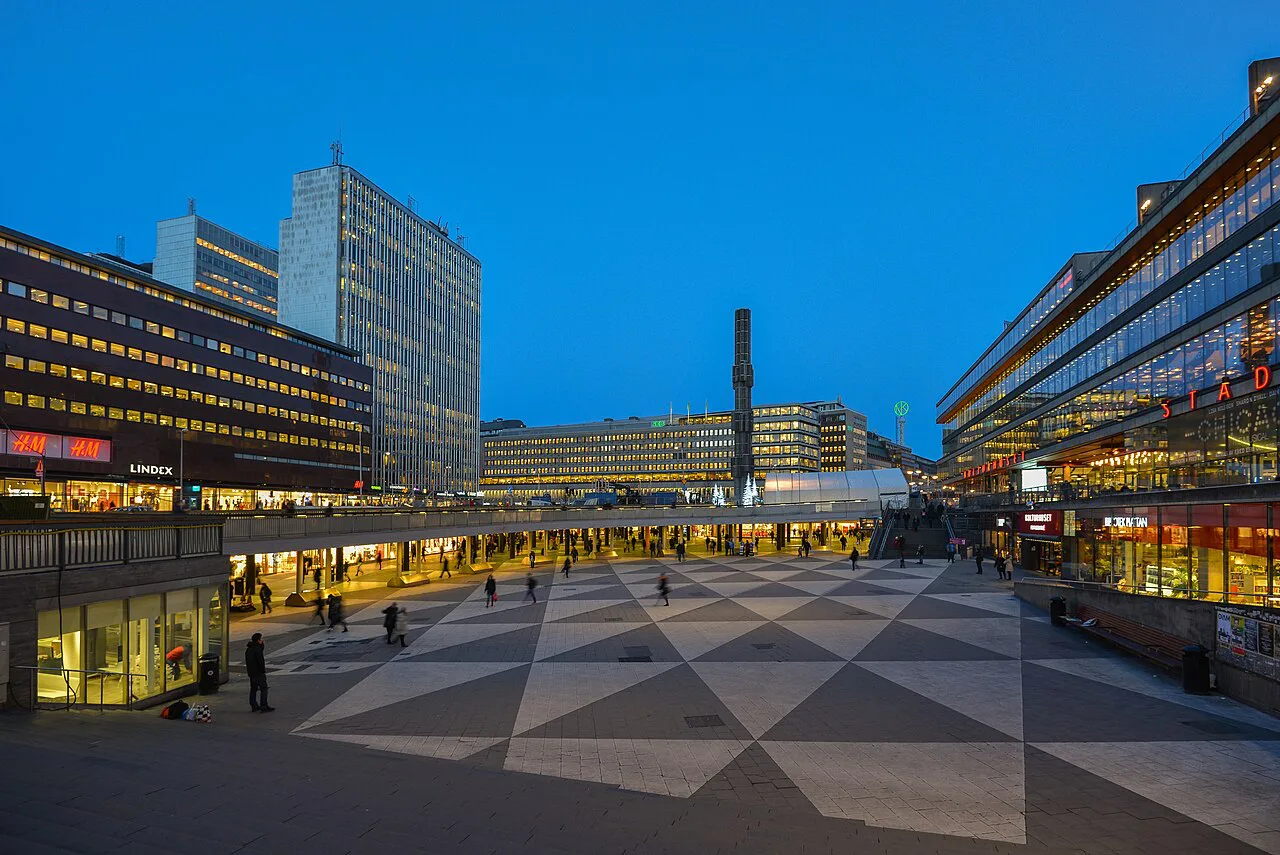
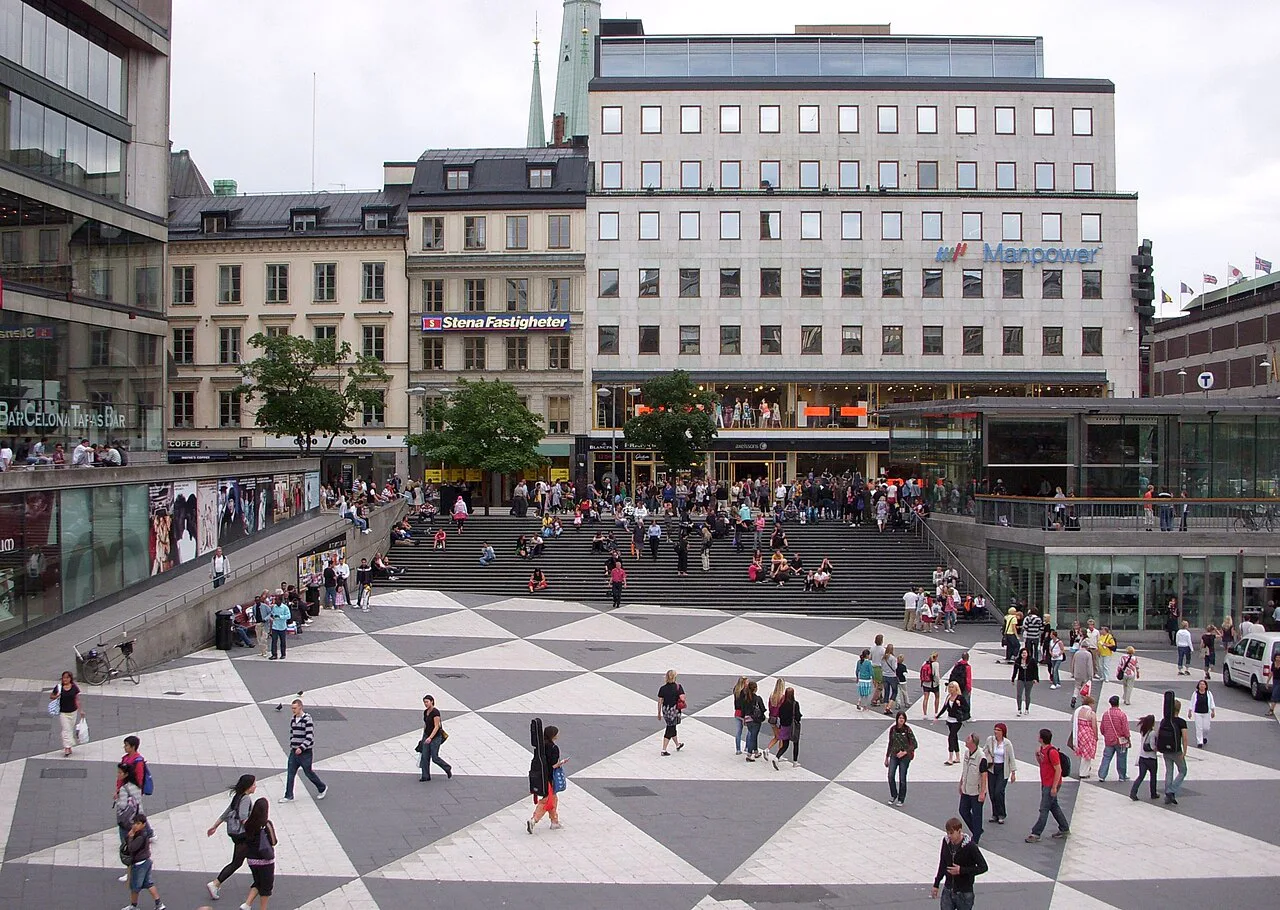
The famous black-and-white triangular tile pattern covers the lower level, which locals simply call Plattan. It is one of the most photographed spots in the city and hosts everything from street performances to political demonstrations, so what you find on any given day depends on the day. Look down as well as up: the pattern is the point, and photographs work best from the steps leading down to it.
The lower level also has kiosks and a constant flow of people, and as with any major city hub it is worth keeping an eye on your belongings. Police are often present, sometimes to prevent crime and sometimes to intervene. Plattan is safe enough in daylight and busy enough in the evening, but you should treat it as you would any crowded transport interchange.
The Kristallvertikalaccent Glass Obelisk After Dark
Standing in the centre of the square is the Kristallvertikalaccent, a glass obelisk 37 metres tall. At night it is illuminated and acts as a glowing landmark for anyone finding their bearings in the city centre. It is the one element of Sergels Torg worth deliberately returning to after sunset, when the glass picks up light and the tiles below lose theirs.
You do not need to book anything or wait in line to see it. Walk around the base for a couple of minutes, then look back at it from the top of the steps for the full height against Kulturhuset's glass facade. In daylight the obelisk reads as sculpture; after dark it reads as navigation, which is precisely how it functions for locals crossing the city.
Kulturhuset on the South Side
Kulturhuset, the House of Culture, forms the south side of the square behind a long glass facade. Inside are exhibition spaces, a programme of talks and performances, and Stadsteatern, the city theatre that shares the building. It is the reason Sergels Torg rewards more than a photo stop: you can step off the square and into a cultural centre without planning ahead.
Travellers with children should head for Rum för Barn on the fourth floor. It is a library and arts space for children and a useful fallback when rain interrupts a day of walking. Check Kulturhuset's own programme for what is on during your dates, since exhibitions and theatre performances change through the year.
Drottninggatan, Åhléns City and Hötorgshallen Nearby
Drottninggatan, Stockholm's long pedestrian shopping street, crosses the square and runs southeast towards Gamla Stan. In the other direction it leads to Hötorgshallen, the food market hall, which makes a sensible lunch stop if you are combining shopping with sightseeing. Åhléns City department store also fronts the square, with a food hall in its basement that is a quick alternative to the kiosks outside.
These three edges are what give Sergels Torg its shape as a place: a department store, a market hall and a shopping street feeding into one open space. If you want a single loop, walk from the square up Drottninggatan to Hötorgshallen, then back through Åhléns City and out onto Plattan. That covers the practical side of the square in under an hour.
How Long to Allow and When It Is Busiest
Give Sergels Torg twenty to thirty minutes if you are only looking, and an hour or more if you go into Kulturhuset or eat at Hötorgshallen. It is a working square rather than a destination, so the time you spend is set by what you do at its edges. Build it into a walking route rather than making a special trip.
The square is at its busiest during weekday commuting hours, when T-Centralen empties onto Plattan, and again at lunchtime when the surrounding shops and food halls fill up. Weekday mornings and early afternoons give you the clearest view of the tiles and the obelisk without a crowd in front of them. Evenings are quieter but darker, which suits the illuminated obelisk.
A Transport Hub and Protest Venue: What to Expect
Because Sergels Torg doubles as a transport hub and a gathering place, expect crowds, speeches, stalls and the occasional demonstration rather than a calm civic square. That is part of its character and worth seeing rather than avoiding, but it does mean you should not plan a quiet picnic on Plattan. If a large gathering is underway, watch from the steps and keep moving.
The practical upside is that everything you need is within a few minutes: metro and rail connections below, shops and food above, and the old town a straight walk away. The downside is noise and foot traffic, which makes Sergels Torg a poor choice for a relaxed coffee stop. Use it as a crossing point and a landmark, not as a place to settle.
Nearby Sights Within Walking Distance
Follow Drottninggatan southeast for roughly fifteen minutes and you reach Gamla Stan, the old town, where the Riddarholmen Church and the Stockholm Palace sit among the lanes. The contrast is the best reason to start at Sergels Torg: modern paving and glass on one side, medieval streets on the other, all on foot.
North and east of the square, the city centre continues with Adolf Fredriks Kyrka and Gustaf Vasa kyrka within a reasonable walk for anyone following a church trail. For a heavier museum day, the Nationalmuseum on Södra Blasieholmshamnen is a longer but flat walk through the centre. Pick one direction rather than trying to cover all of them from Plattan.
If you have a spare half-day and want art beyond the centre, Moderna Museet and the Hedvig Eleonora Church are both reachable on foot or by a short metro hop. The wider list of things to do in Stockholm helps you slot Sergels Torg into a one- to four-day plan without overcommitting to the Norrmalm area.
Is Sergels Torg Worth a Stop?
Yes, but as a crossing point rather than a destination. Sergels Torg earns its place on a Stockholm itinerary because you will pass through it anyway on the way from T-Centralen, and the tiles, the 37-metre obelisk and Kulturhuset give you something concrete to look at while you do. If you want more of the city's sights in one list, see Stockholm Attractions: 29 Visitor Guides.
Pair it with Gamla Stan at the far end of Drottninggatan, allow half an hour on the square itself, and go inside Kulturhuset only if the programme appeals. That keeps the stop proportionate and leaves the rest of your day for the old town.