Uppsala Architecture: The Buildings and Styles That Shape the City
Uppsala architecture runs from the cathedral and the 1877–1887 university main building to national romantic brick, functionalism and 1980s postmodernism.
On this page
Uppsala architecture is best read as a century of reinvention layered onto a mediaeval core. The city centre was torn down and rebuilt in successive waves during the 1900s, so one street can take you from Art Nouveau plasterwork to 1980s postmodern colour, and the quickest way in is to start at the cathedral and the university main building, then follow the styles outwards.
This guide groups the buildings by period so each style has one clear example to look for, then sets out an area-by-area sequence for seeing them on foot. It also names which styles sit close to the centre and which, like Gottsunda kyrka, are a deliberate detour.
What defines Uppsala architecture in one answer
The city's character comes from repeated rebuilding rather than one signature style. In the 1900s Uppsala grew fast, older buildings in the centre were demolished and replaced, and the townscape was reshaped by each new architectural fashion in turn. That is why a short walk passes Art Nouveau facades, national romantic brick, stripped-back neoclassicism, functionalism, brutalism, modernism and finally playful postmodernism.
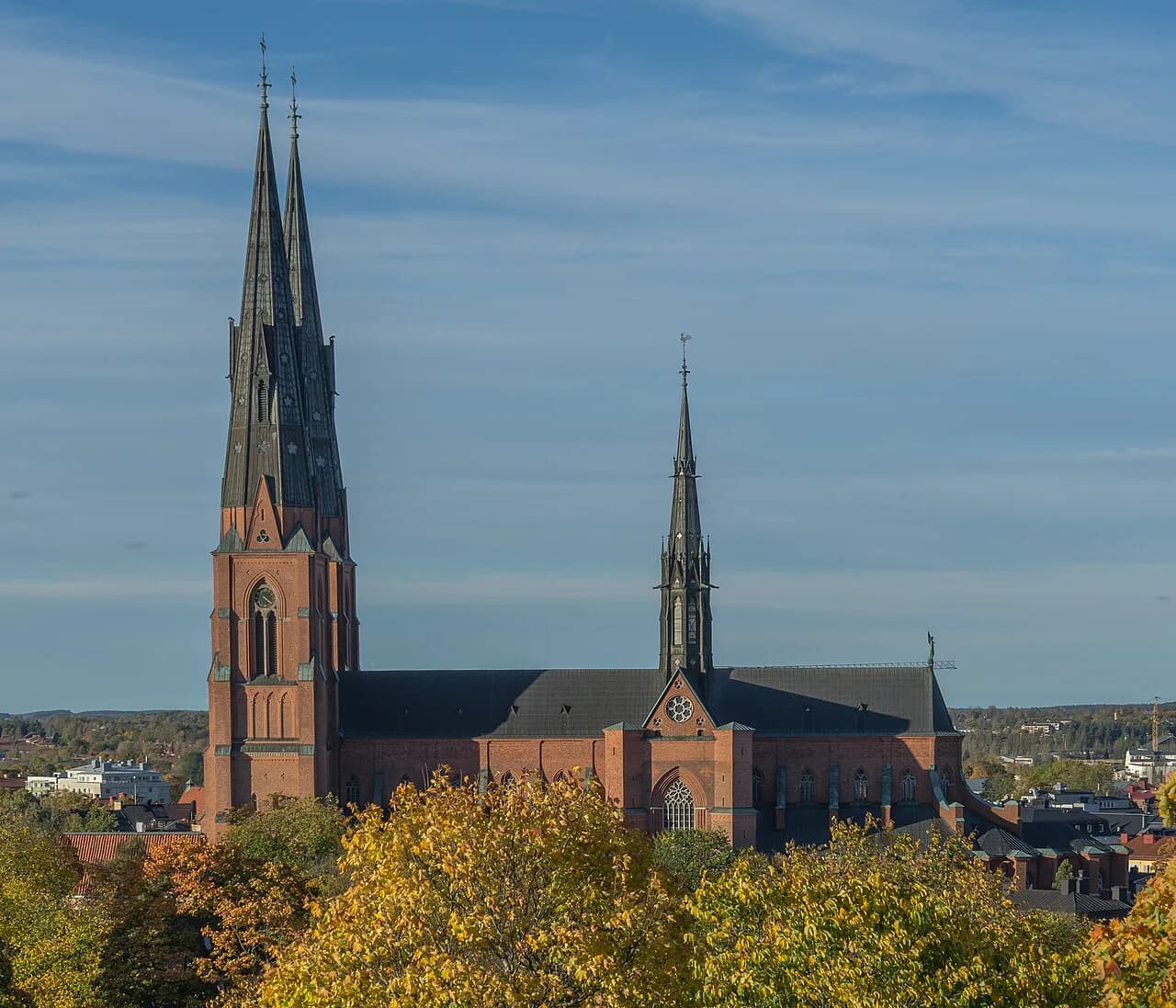
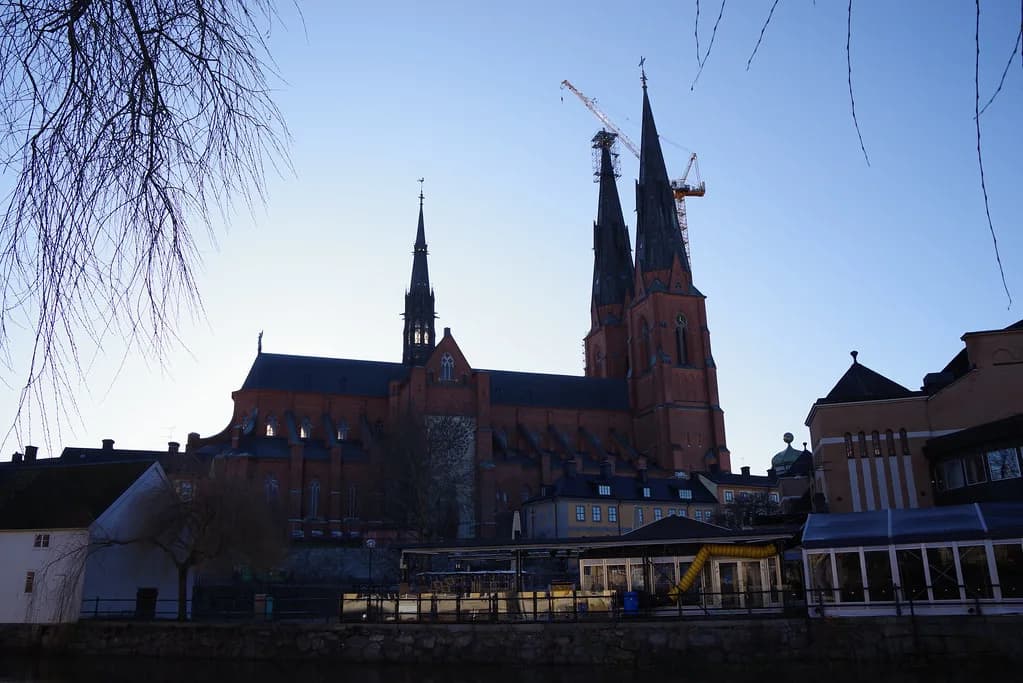
For a first orientation, stand where the cathedral and the university meet. The main building and its park were built between 1877 and 1887 to drawings by Theodor Holmgren, next to the cathedral and the university's first building, and that cluster gives you the historic baseline against which all the 20th-century experiments read.
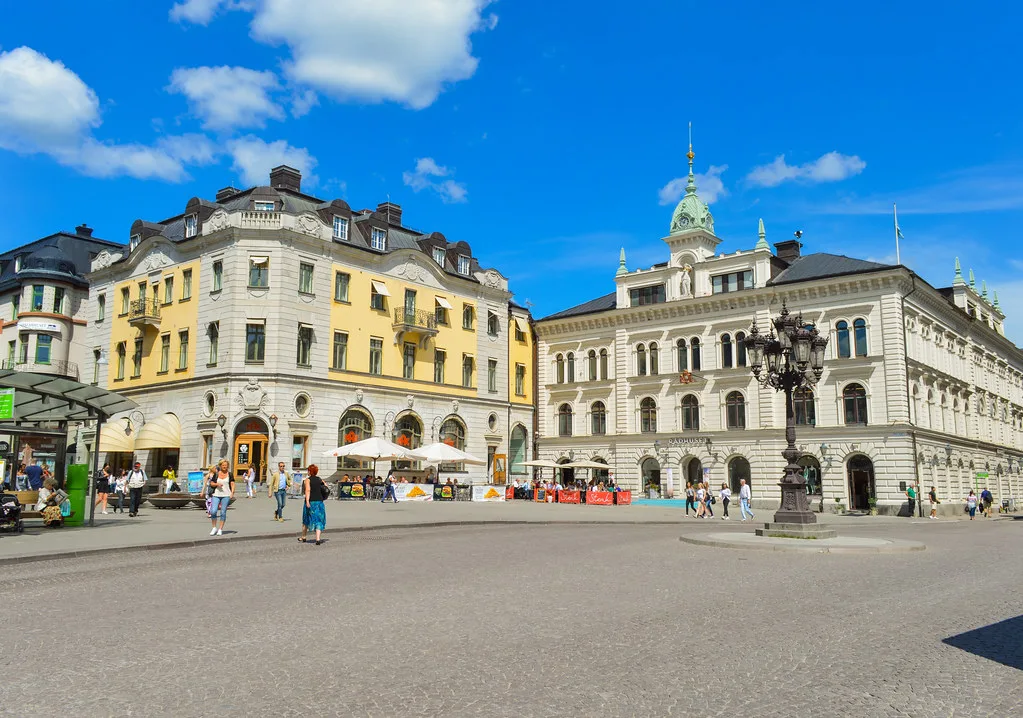
Where to start: the cathedral and the university main building
Begin with the historic core around the cathedral and the university's main building, because everything later in the city is a reaction to it. The main building and its park were laid out to Theodor Holmgren's drawings between 1877 and 1887, right beside the cathedral and the university's first building, and the grouping is compact enough to take in on one pass.
Use this stop to fix the city's geography in your head rather than to tick off a list. Once you have seen where the cathedral, the main building and its park sit relative to each other, the later buildings fall into place as a ring of 20th-century additions around them. If you want the wider sightseeing picture alongside the architecture, the full set of things to do in Uppsala slots the same landmarks into a day plan.
Art Nouveau and national romantic buildings from the early 1900s
Art Nouveau was in fashion in the early 1900s, and in Uppsala it shows up as soft, rounded lines, decorated plastered facades, ironwork details and stained-glass windows inspired by natural forms. Look for plastered fronts with curved window heads and decorative metalwork rather than plain brick.
National romantic architecture arrived at the same time and looks quite different. It drew on older buildings such as mediaeval castles, so it has a heavy, solid feel and is usually built of brick or hewn stone. Vasahuset, dated to 1906 and 1910, is the anchor for this period in the city's architecture trail, and comparing its mass with an Art Nouveau facade nearby is the clearest way to see the two styles side by side.
S:t Erikshuset, from 1929, marks the shift away from decorated fronts towards something plainer, sitting at the tail end of the 1920s. Slöjdgatan, with buildings from the 1920s, is useful as a street to walk rather than a single address, because it lets you see how several facades from the same decade sit together. Read these as a transition strip between the early-century styles and the neoclassicism that follows.
1920s neoclassicism and the 1925 to 1927 Vaksalaskolan
In the 1920s a terse neoclassical style became popular, modelled on Greco-Roman architecture. The giveaways are columns, medallions and cornices, and the overall effect is more restrained and symmetrical than the national romantic brickwork before it.
Vaksalaskolan, built between 1925 and 1927, is the building to find for this decade, and it shows how civic architecture of the period borrowed classical vocabulary for schools and public institutions. The dates are construction dates, so treat them as a way of ordering the styles on your walk rather than as any kind of visitor information.
1930s functionalism: the Värmlands nationshus and Villa Göth
From the 1930s an entirely new style took over: functionalism, which replaced decoration with an emphasis on function, hygiene and light. The new houses had straight, pure lines, flat roofs, large windows and no ornamentation, so they look conspicuously plain next to the neoclassical buildings of the previous decade.
Värmlands nationshus, from 1930, is the student-nation example to look for, and it shows how quickly the new style was adopted for institutional buildings. Villa Göth, from 1950, continues the story into the post-war decades, and the two together let you trace how functionalism settled into a house type rather than a single landmark.
1950s brutalism and the Tuna backar area
The 1950s brought brutalism, a style with no room for sentimentality, where buildings were ideally functional and honest and the structural elements and technical installations were left fully visible. In practice that means exposed structure, hard surfaces and a refusal to hide how the building is put together.
Tuna backar, from around 1950, is where to see this thinking applied at the scale of an area rather than a single facade. Walk it as a piece of town planning as much as architecture: the interest is in how the buildings relate to each other and to the ground, not in decorative detail. Berthåga Cemetery, dated 1965 and 2001, is a later site on the same architectural trail if you want a second example in an outlying setting.
1960s and 1970s modernism: the City Hall, Studentstaden and Pharmacia's former head office
Towards the mid-1900s functionalism developed into modernism, which is often large-scale, built from repeated concrete units, and shaped by industrialised and standardised construction. The result is the kind of big, regular block that reads as a single system rather than a collection of details.
Uppsala City Hall, dated 1964 and 2021, is the civic example and useful precisely because the two dates show a modern building being reworked decades later. Studentstaden, from 1956, and Pharmacia's former head office, from 1972, fill in the residential and commercial sides of the same story, and Västmanlands-Dala nationshus from 1965 adds the student-nation version.
These are working buildings rather than showpieces, so the reward is in noticing repetition, proportion and the honesty of the concrete. If you are short on time, pick one of the three and look at it properly instead of racing between all of them.
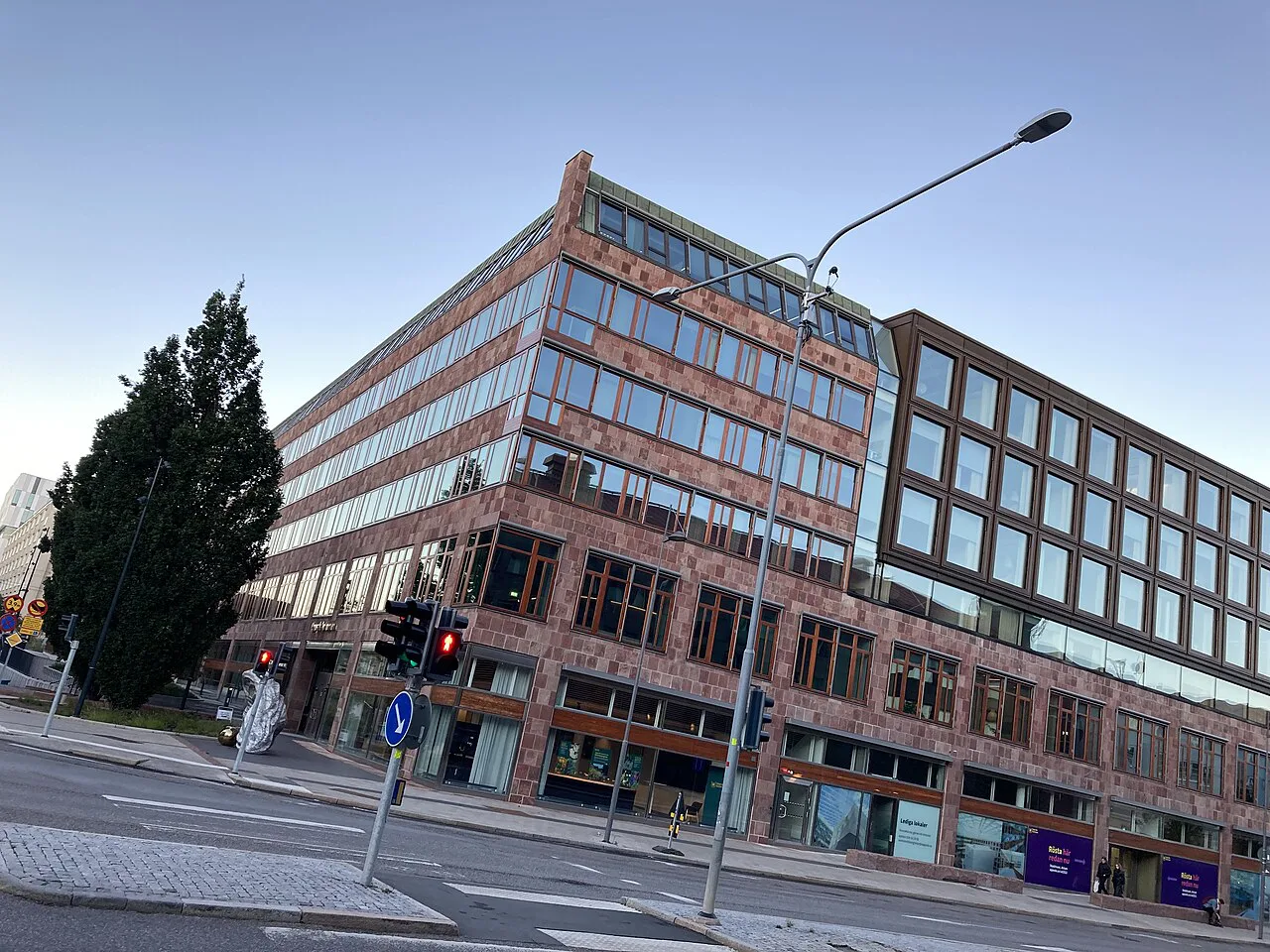
1980s postmodernism and the City Library
Postmodernism arrived in the 1980s as a reaction to the strict design idiom that came before it. It is characteristically playful and colourful, quotes historic architecture and mixes different styles with a sense of humour, so it is the easiest style in the city to spot from a distance.
The City Library, from 1987, is the building to see for this decade, and its date places it neatly between the late modernism of the 1970s and the 1990 Riksbankshuset. Set the two against each other and the change in mood is obvious: one restrained and institutional, the other much more willing to play.
Gottsunda kyrka and Berthåga Cemetery: the outlying stops
Two outlying sites are worth naming separately, because both are a real detour rather than a stop on a central walk. Gottsunda kyrka was built in 1980 and designed by architect Carl Nyrén as a wooden church with rose-toned wooden panelling, which makes it a distinctive late-20th-century counterpart to the city's stone and brick landmarks.
Berthåga Cemetery, dated 1965 and 2001, sits in the same outlying category as a site dated to the later 20th century rather than a central stop on a walk. Like Gottsunda kyrka, it is best treated as a half-day commitment: choose one and give it time instead of trying to bolt either onto a tight central itinerary.
How to see the architecture on foot: an area-by-area sequence
Start in the historic core with the cathedral and the university main building and park, then work outwards by decade. Take the early-1900s cluster around Vasahuset and S:t Erikshuset, add Slöjdgatan, then move to Vaksalaskolan for the 1920s and the Värmlands nationshus and Villa Göth for functionalism. That first half of the walk covers the densest stretch of change in a relatively small area.
Then shift to the post-war layers: Tuna backar for brutalism, the City Hall, Studentstaden, Västmanlands-Dala nationshus and Pharmacia's former head office for modernism, and the City Library for postmodernism. Keep Gottsunda kyrka and Berthåga Cemetery for the end or a separate outing. If you would rather follow a fixed line through the centre, the Uppsala walking tour format suits this kind of period-by-period route.
The old town streets are the natural place to pause between stops, and they are also where a fika break fits best before the post-war section. Beyond the architecture, Uppsala has plenty of other draws for a short break, so treat this route as one thread among several rather than the whole trip.
Which styles you can skip if time is short
With a day or less, concentrate on the historic core and the early-1900s buildings, because that is where the densest concentration of contrasting styles sits. The neoclassical and functionalist examples are close enough to fold into the same walk, so you lose little by adding them.
The honest trade-off is the post-war and outlying material. Brutalist and modernist buildings reward attention but are less immediately striking, and Gottsunda kyrka and Berthåga Cemetery cost you a journey out of the centre. If your priority is the city's best-known sights rather than a style-by-style survey, the Uppsala old town streets and the main attractions will give you more per hour.
If you are choosing between the two outlying sites, pick Gottsunda kyrka for Carl Nyrén's 1980 wooden church and its rose-toned panelling, and Berthåga Cemetery if you want the later cemetery site. Either way, drop one rather than trying to see both and the centre in the same afternoon.
How to build your own architecture walk
Build the walk around one idea: that Uppsala was rebuilt repeatedly across the 1900s, and that each decade left a building you can point to. Anchor the start at the cathedral and the university main building and park, take the early-1900s square and street stops next, then decide whether you have time for the post-war layer and the outlying sites.
If you only have an afternoon, stay central and skip the detours. If you have a full day, add Tuna backar, the City Hall and the City Library, and save Gottsunda kyrka or Berthåga Cemetery for when you can give one of them proper time. For more, see Uppsala old town.
Explore more Uppsala guides
Frequently Asked Questions
What is the main building of Uppsala University and when was it built?
The university's main building and park were built between 1877 and 1887 to drawings by Theodor Holmgren, next to the cathedral and the university's first building. That cluster gives you the historic baseline against which the 20th-century styles in the centre read.
What is Swedish architecture like in Uppsala?
Uppsala moved through a sequence of styles in the 1900s: Art Nouveau and national romantic work at the start of the century, terse neoclassicism in the 1920s, functionalism from the 1930s, brutalism in the 1950s, modernism towards the mid-century and playful postmodernism in the 1980s. Each style has clear markers, from decorated plaster facades and stained glass to flat roofs and bare concrete.
Sources
Notes for your next Swedish city break
Optional updates to our Sweden guides.
You might also like
Continue reading
More guides you'll find useful