
Sankt Petri kyrka: Malmö's St Peter's Church for Visitors

Sankt Petri kyrka, St Peter's Church, is the brick church that rises above central Malmö a few minutes from the canal by Malmö central station, and it deserves between 30 and 45 minutes of a city-break morning. Its value is in the interior: a Reformation-stripped sanctuary with a richly carved altarpiece, a side pulpit carried on Moses, medieval frescoes in the Chapel of the Merchants and stained glass from the 1930s. This guide covers what to look for, how the building's history explains its appearance, where it sits in the city and what to pair with the visit.
What Sankt Petri kyrka is and why it is worth a stop
Sankt Petri was built between 1300 and 1380 as a Catholic church in Malmö, then Denmark's second-largest city. It became a Lutheran church during the Reformation, and that shift, rather than any later rebuilding, is what you see inside: whitewashed walls, stripped ornament and a sanctuary that reads bright and airy rather than dark. For a visitor it is a compact lesson in northern European religious history, close to Malmö's main station.
The exterior looks much as it did when the church was constructed, so the spires are all most day-trippers notice from across the water. Step inside and the building changes character completely. It is in active use for worship, so treat it as a working church rather than a museum hall.
It is one of several strong stops in central Malmö, and the Malmö Attractions: 17 Visitor Guides collection is useful if you want to build the church into a half-day route. The church suits anyone interested in architecture, the Reformation or medieval church fittings, and it is easy to combine with the squares nearby.
Where the church sits in Malmö and how to reach it on foot
The church stands in the old centre, just across the canal from Malmö central station, which makes it one of the first sights you can reach after arriving by train. From the station area, cross the water and look for the brick tower rising above the surrounding roofs. The walk is short and flat, so it fits naturally into a first hour in the city.
Because the church sits in the dense old centre, you will pass other places worth a look on the way. Lilla Torg, Malmö's small cobbled square lined with old buildings, is a natural companion stop nearby, and it gives you a reason to slow down rather than walk straight from station to church and back.
Allow five to ten minutes on foot from the station to the church door and keep the map simple: the canal, the old centre and the church tower are all you need to navigate by. If you want a longer loop, the wider Things to Do in Malmö guide helps you order the old centre with the waterfront and the parks.
The building's dates: 1300 to 1380, then the Reformation
Construction ran from 1300 to 1380, and the church kept its Catholic character for well over a century afterwards. The Reformer Claus Mortensen was active as a priest here, and in 1529 he led the destruction of much of the church's ornamentation as too Catholic, one of only four outbreaks of iconoclastic violence during the Danish Reformation. Of more than sixty pre-Reformation altarpieces, only one survived more or less intact.
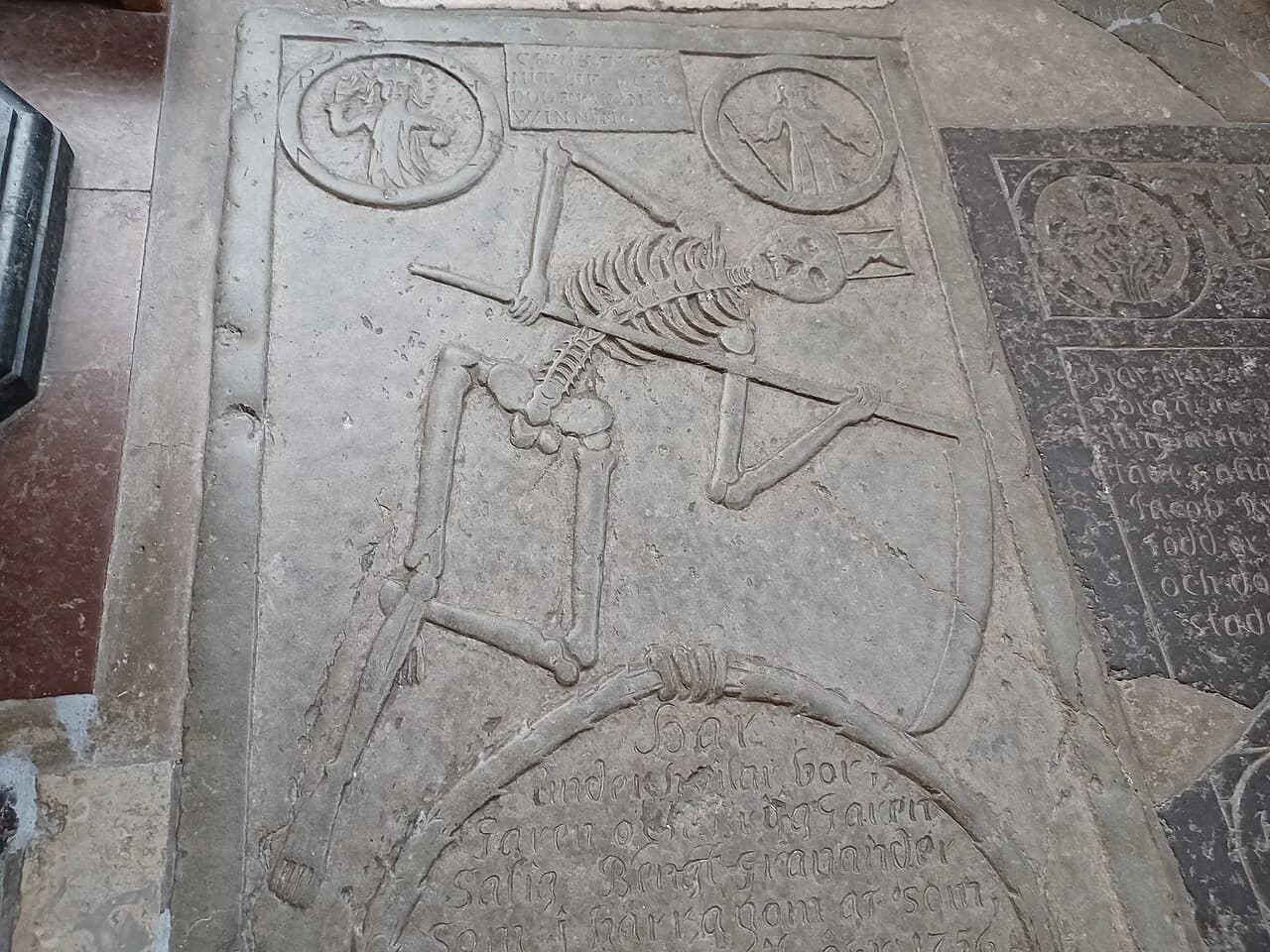
In 1555 the interior was whitewashed, which is why the nave now looks so pale and open. Claus Mortensen's tombstone in the church carries an epitaph calling him destroyer of the papal cult and sower of the true gospel. Knowing that sequence, violence, stripping, whitewash, explains why the sanctuary feels plain rather than unfinished.
Malmö's story is often told through its modern landmarks, but the church predates them by centuries. For contrast later in the day, Turning Torso, Malmö's Santiago Calatrava tower, shows how far the city has travelled since the Reformation.
Inside the church: the altarpiece, side pulpit and medieval frescoes
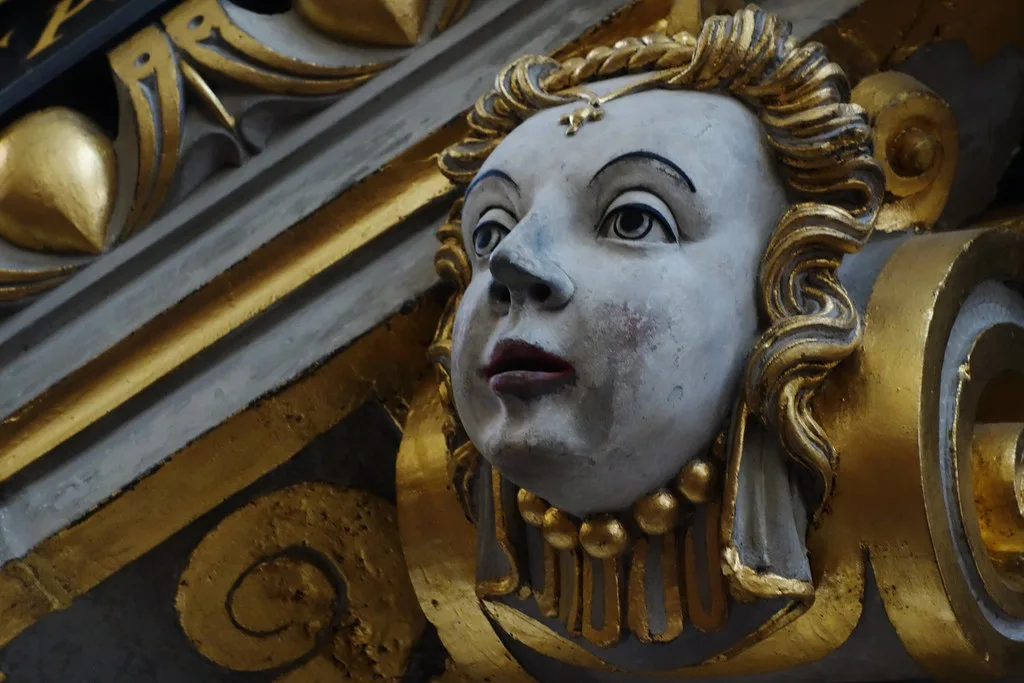
The altarpiece is the centrepiece of the interior, and it was rolled in over Claus Mortensen's grave about fifty years after his death. Read it from the top: Christ, then Peter and Paul, then the evangelists Matthew, Mark, Luke and John, then the Swedish royal crests, with Moses and John the Baptist at the bottom. The carved side pulpit is supported by Moses, a visual argument that the priest's gospel rests on the Ten Commandments, and a small figure of the Evil One hides above Moses's left shoulder.
In the side chapel known as the Chapel of the Merchants, medieval frescoes survive as some of the best preserved in the Nordic region. They were whitewashed during the Reformation and restored in 1906 and 1907, and the most visible figure is the Veil of Veronica, with Peter holding the veil on the right. Look down as well: the chapel floor is made of gravestones.
The interior is also a stop on the Pilgrimsvägen Skåne Blekinge, a long pilgrimage road linking Santiago de Compostela in Spain, Vadstena in Sweden and Nidaros in Norway. If quiet, slow viewing appeals, this framing is worth remembering while you circle the nave.
The organs, stained glass and gravestone floor
The church holds several organs from different eras: instruments from 1797, 1914 and 1951, plus a high-tech organ installed in 2019, one of the most modern in Europe. A c.1500 organ, one of the world's oldest still playable, has been moved to a museum. A single keyboard can play all four of the instruments still in the church at once.
The tall stained-glass windows showing the lives and martyrdoms of Peter and Paul date from 1935 to 1937 and were made by the artist Hugo Gehlin. They add the colour that the whitewashed walls otherwise take away, so save a few minutes to look up before you leave. The gravestone floor underfoot is a reminder that this has been a burial and worship site for centuries.
How much time to allow and when to go for quiet viewing
Set aside 30 to 45 minutes for the church itself: long enough to read the altarpiece, find the Chapel of the Merchants and look at the windows, short enough to leave room for the rest of central Malmö. For photographs without people in the frame, aim for a weekday morning rather than a service time.
Services take priority over sightseeing, and a service may begin while visitors are looking round, so be ready to step back or leave quietly. Later in the day, Malmö Live and Malmö Opera give you evening options if you want to round off the visit with music, and both are a short walk from the old centre.
Opening hours, services and tickets: where to confirm before you travel
Check the parish's own service times and visitor arrangements, either on the church's website or on the notice board at the door, rather than relying on second-hand listings. Do not assume the doors are open all day, and do not assume entry is ticketed or free: neither is set out in the visitor information we could check. If you are coming specifically to hear the organs or see a concert, confirm the programme before you travel.
Guided tours are sold by outside operators, and St Peter's Church tour listings describe the church as a must-see for anyone interested in architecture and Swedish history. Book through the operator if you want a guided visit, but treat the church's own published information as the authority on when the building is open.
Nearby: what to pair with a visit in central Malmö
The old centre around the church rewards a slow loop. Lilla Torg is the obvious next stop for its cobbles and old buildings, and from there you can walk on to the parks and museums without needing transport. If you only have an hour, the church plus the square makes a satisfying short outing.
For a longer half-day, Malmö Museum and Kungsparken Malmö sit within walking distance of the centre and pair well with a church visit. Malmö Konsthall and Form/Design Center Malmö suit anyone who wants contemporary art and design after the medieval interior, and Malmö Stadsbibliotek is a calm stop if you need a break.
Malmöhus Castle, Malmö's moated fortress, is another strong option nearby, and the Moderna Museet Malmö and Pildammsparken give you two more reasons to extend the walk south and east. If you are planning several sights in one day, the Malmö Rådhus and the surrounding squares keep the route compact and walkable.
Is Sankt Petri kyrka worth the stop?
Yes, if you have any interest in the Reformation or medieval church interiors, and especially because it costs you only a short walk from the station. The altarpiece, the pulpit and the Chapel of the Merchants frescoes are the highlights, and 30 to 45 minutes is enough to see them properly. Pair the visit with Lilla Torg and the old centre and you have a solid half-day in Malmö.