Vikings in Sweden: Where to See Viking-Age Sites and Runestones
Where to see Sweden's Viking Age: Birka, Gamla Uppsala, Uppåkra and the country's runestones, plus what the sites and finds reveal about the period.
On this page
The Viking sites worth your time in Sweden are Birka and Sigtuna near Stockholm, Gamla Uppsala just outside Uppsala, and the Uppåkra area in Skåne, backed by runestones scattered across the Uppland and Skåne countryside. "Viking" originally described a raider who went out to plunder, not everyone who lived in Scandinavia during the period. This guide covers what each site shows, how it fits a one- to four-day city break, and what the archaeological record does and does not support.
What 'Viking' actually meant: raiders, traders and the Scandinavians who stayed home
The word may come from vìkingr, meaning pirate, or from Viken, the area around the Oslo fjord, and in the Viking Age it referred specifically to someone who went out raiding and plundering. Most Scandinavians never went; ordinary people were described as norroenar, and nearly all of them were farmers or slaves. A person could sail out occasionally to raise money to establish themselves on their own land, then return to farming.
In the eighth century most people in Scandinavia lived by farming, grazing animals, hunting and fishing, whether in villages, isolated farms or larger estates. The whole family worked the farm, the household ate and slept together, and larger estates had outbuildings for cooking, brewing and craftwork. Towns developed later in the Viking Age, which is why the Swedish sites that matter most are trading places and cult sites rather than cities.
The Viking Age in Sweden: fragmented kingdoms and a trading network to the east
Viking-Age Sweden was split into petty kingdoms, or earldoms, each ruled by a local chieftain, and these polities fought each other for regional control; some of their territories match today's provinces. Sweden was also tied into an extensive trading network that Swedish Vikings ran through present-day Germany, Poland, Ukraine, Russia and Turkey, reaching as far as the Caspian Sea. That eastern pull is the core of the Swedish story, distinct from the westward raiding that dominates popular accounts.
What country did Vikings raid the most? There is no simple ranking in the surviving record, and the answer depends on what you count: coastal monasteries, defended towns or sustained settlement. What is clear is that Swedish Vikings directed much of their effort east into present-day Poland, Ukraine and Russia, while Danish and Norwegian groups concentrated on the British Isles, Normandy and the continent.
How accurate are television depictions of Vikings? Dramas compress the period and foreground raiding, when most people in Viking-Age Scandinavia were farmers, fishermen and craftspeople, with only a relatively minor share of the population going overseas. Details such as horned helmets belong to later popular imagery.
Two trading centres stand out in Viking-Age Sweden: Birka, near modern Stockholm, and Uppåkra, south of Lund in Skåne, which was then part of the Kingdom of Denmark. Uppåkra is described as the largest and most populous settlement in the region, comparable with Hedeby in southern Jutland. The Swedish Vikings were also state builders, credited with founding Kievan Rus', known in Old Norse as Garðaríki.
Uppsala and Gamla Uppsala: the temple site and the mounds
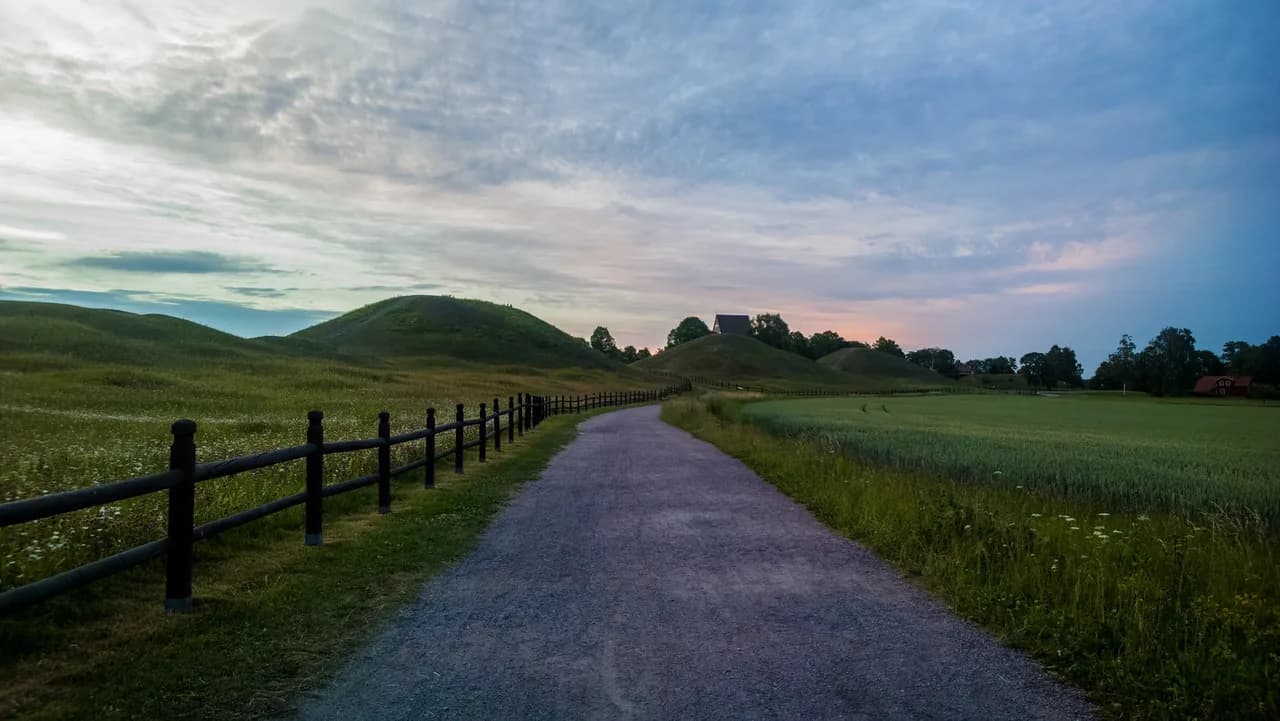
Gamla Uppsala, now a village near the university city of Uppsala in Uppland, was an important religious pilgrimage site, with a temple where animal sacrifices known as blóts were made to the Norse gods. The celebrations fell roughly around the time of the modern Christmas holidays or Halloween, so the ritual calendar mattered to the farming year rather than to a fixed modern date. The mounds themselves are the reason to come: they are the surviving landscape of that cult centre.
Allow an hour or two on site to walk between the mounds and the church, and treat the visit as a landscape stop rather than a museum one, since the emphasis is on what stands in the ground. It pairs naturally with a day in Uppsala itself, which is a short hop from Stockholm and worth a full afternoon on its own.
Birka near Stockholm: the Viking Age trading town
Birka sits near modern Stockholm and was one of Viking-Age Sweden's prominent trading centres, the place to picture if you want to understand how goods from the east reached the Baltic. Because towns only developed later in the Viking Age, Birka belongs to the period when trade and craft were consolidating into permanent settlements. It is the most convenient Viking site for a Stockholm city break.
Plan Birka as a half-day to full-day outing and build slack into your timetable, because reaching the island depends on seasonal boat services whose timetables are published by the operators closer to your dates. If your break is short, choose Birka over Sigtuna for the trading-town story and visit Sigtuna for the runestone and townscape story.
Sigtuna and Uppland's runestones
Sigtuna is the other easy day out from Stockholm, and it gives you a compact townscape alongside carved stones rather than an excavated trading site. Uppland is the heart of Sweden's runestone country, and the carvings are outdoor monuments you can see without opening hours or tickets.
Sweden has a greater density of runestones than any other Scandinavian country, with an estimated 1,700 to 2,500 across the countryside, carved in the runic alphabet known as futhark. Many are Varangian stones commemorating men who travelled east, which ties the carvings directly to the routes described above. Read them as memorials to individuals, not as chronicles of a nation.
Uppåkra and Lund in the south
Uppåkra, south of Lund in Skåne, was one of the two largest urban centres in Viking-Age Scandinavia alongside Hedeby, and the site is the south's answer to Birka. The land was Danish at the time, which explains why the archaeology here sits within a Danish rather than a Swedish narrative. Lund makes the obvious base for a southern city break that includes it.
Skåne also has two ring forts, or trelleborgen, of the kind the Danes built in the early eleventh century as trading centres or as bases for the invasion of England. They are Borgeby, north of Lund, and Trelleborg in the town of the same name. For a southern trip, pair Uppåkra with one of these rather than trying to fit both.
Viking Age centres in the Gothenburg and Malmö orbit
From Malmö, Uppåkra and Trelleborg are the practical Viking-Age targets, both within reach of the city for a half-day or day trip. Further afield, Foteviken at Höllviken in Skåne is an open-air museum with reconstructed Viking-period houses, so it shows a modern reconstruction rather than an excavated town. Go there to see how buildings are interpreted; go to Uppåkra for the ground itself.
Gothenburg is not one of the bases described above for the Viking-Age sites in this guide, so treat the southern sites as a separate leg of the trip rather than a day out from the west coast. If your break is one to four days, that separation is the honest trade-off: you cannot see Stockholm's and Malmö's Viking sites in the same short trip without losing a day to travel.
Why Sweden has so many runestones, and where you see them
Runestones were carved with the futhark alphabet used before and during the Viking Age, and Sweden's density reflects how widely the commemorative habit spread among farming families rather than a single royal programme. The stones record local people, their travels and their deaths, which makes them the closest thing to named individuals from the period you can see outdoors.
For a city break, Uppland around Sigtuna and Uppsala gives you the highest concentration within easy reach, while Skåne has its own carved stones near the southern sites. Bring the location of individual stones with you rather than expecting signage at every one, and pick two or three rather than trying to chase a list.
The Thing: how Viking societies made and enforced laws
Viking societies were governed by local assemblies called Things, which discussed political matters, made laws and decided punishments for those who broke them. Free people could all attend and speak, and assemblies were usually held once a year. Because few people could read, a Law Speaker recited the existing laws aloud at the governing assembly each year.
The system left a long afterlife in place names and institutions: Thingvellir in Iceland means parliament plains, and the Althing there is believed to be the world's oldest surviving law-making assembly on record. It met from 930 until 1800 and again from 1843. A Thing is still held each 5 July on Tynwald Hill on the Isle of Man, where meetings have run for over a thousand years.
Viking society: jarls, karls and thralls
Viking society had three levels: nobles known as jarls, free people known as karls, and slaves or peasants called thralls. The sharpest divide was between free and unfree people, because a free person could carry weapons and speak at the Thing, while an unfree person had no rights under the wording of early medieval law. Status also ran through personal items: men could hold rank through weapons and women through keys.
Women ran the household on the farm while men ploughed and represented the family at the Thing, and both men and women could be rich and powerful. That detail is worth carrying to the graves and hoards you see in museum collections, since the objects on display are often the markers of exactly that kind of standing.
What the myths get wrong: horned helmets and a nation of raiders
Popular images of Viking-Age people leave out boat building, navigation and the crafts they excelled in, focusing instead on raiding and plundering. Horned helmets belong to that popular image rather than to the objects and society described in the archaeological and historical record. Treat the raider-first picture as one part of the story, since most Scandinavians never went out as vikingr at all.
Dating is less tidy than the popular version suggests: the Viking Age is traditionally dated from 8 June 793 CE, when Vikings attacked the monastery at Lindisfarne, but different time frames appear depending on the material studied. There is also archaeological evidence of contact with the continent and the British Isles from much earlier. So a single start date is a convention, not a hard boundary.
Are Swedes descendants of Vikings?
Descendants of Viking-Age Scandinavians certainly live in Sweden, but descent is not the useful question: the people of the period were farmers, fishermen, carpenters and blacksmiths, and only a relatively minor proportion of the population went overseas as Vikings. Swedish Vikings also sailed, raided and settled in Normandy and England alongside Danish and Norwegian groups, so the genetic and cultural trails run in several directions.
A more grounded way to connect is through what survives locally: stones carved for families who stayed, places like Gamla Uppsala and Uppåkra, and the reconstructed buildings at Foteviken. Those give you something concrete to look at instead of a claim about ancestry.
Which Viking sites fit a one- to four-day city break
From a Stockholm base, take Birka for the trading town and Sigtuna plus the Uppland runestones for the carved-memorial landscape, and fold Gamla Uppsala into an Uppsala day rather than a separate trip. Two of those three fit comfortably into a four-day city break. If you have only a day spare, choose Sigtuna with a runestone stop because it needs no boat connection.
From Malmö or Lund, Uppåkra is the essential visit, with Borgeby or Trelleborg as a second stop and Foteviken for reconstructed buildings. For Gothenburg, plan the Viking sites as a southern extension rather than a day out. Season matters for how much of the outdoor landscape you can comfortably walk, so check what a Swedish city break looks like in a given month before you fix dates.
Which Viking site should you pick first?
Start with Birka if you are in Stockholm and want the trading-town story, or with Sigtuna and a couple of Uppland runestones if you would rather avoid a boat crossing. In the south, make Uppåkra the priority.
Two practical habits make the trip work: confirm boat timetables directly with the operator before committing to a Birka day, and check current opening arrangements for any museum you plan to visit. For broader context before you go, read up on Viking history and, if your break has a spare afternoon, the castles and manor houses that came later.
Explore more Sweden guides
Frequently Asked Questions
What country did Vikings raid the most?
There is no simple ranking in the surviving record, and the answer depends on what you count: coastal monasteries, defended towns or sustained settlement. What is clear is that Swedish Vikings directed much of their effort east into present-day Poland, Ukraine and Russia, while Danish and Norwegian groups concentrated on the British Isles, Normandy and the continent. If you want the Swedish angle, look at the Varangian runestones in Uppland rather than the western raids.
How accurate are television depictions of Vikings?
Dramas compress the period and foreground raiding, when most people in Viking-Age Scandinavia were farmers, fishermen and craftspeople, with only a relatively minor share of the population going overseas. Details such as horned helmets belong to later popular imagery. Objects and sites in Sweden give you a better test: the personal items in graves, the carved memorial stones and the trading places show status, travel and everyday work rather than a nation of warriors.
Sources
Notes for your next Swedish city break
Optional updates to our Sweden guides.
You might also like
Continue reading
More guides you'll find useful